
Exhibition
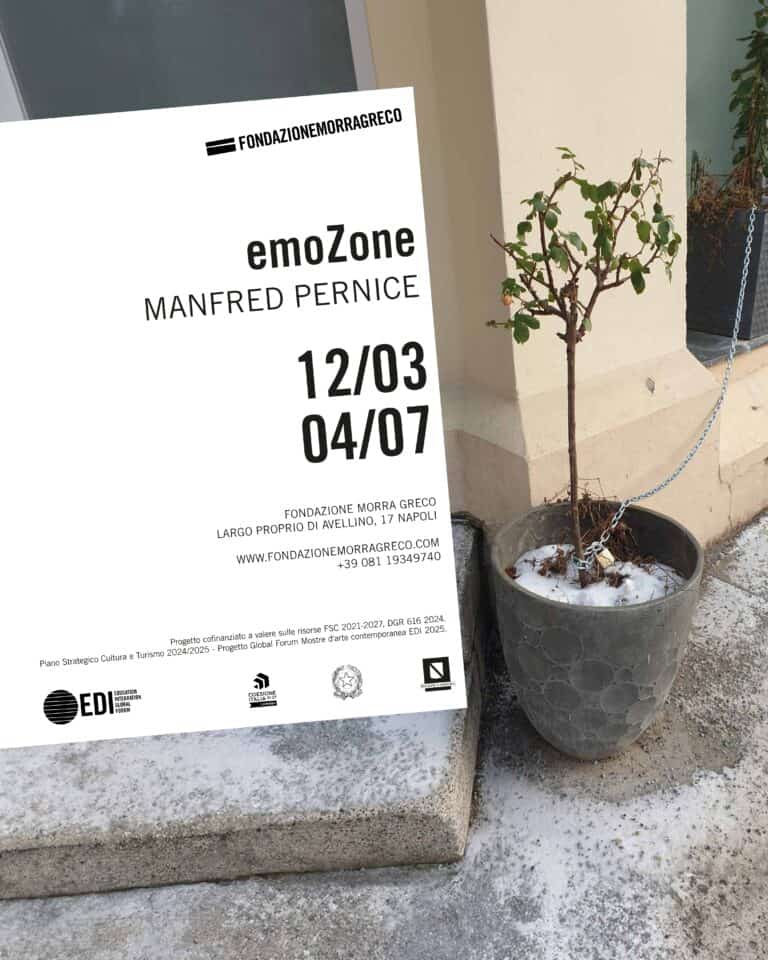
emoZone
By Manfred Pernice
Dates
March 12 – July 4, 2026
Location
Fondazione Morra Greco
emoZone is the first institutional exhibition in Italy by Manfred Pernice (Hildesheim, 1963). In the second-floor salons of Palazzo Caracciolo d’Avellino, a selection of works from the collection of Fondazione Morra Greco is presented together for the first time.
On the Foundation’s third floor, a new site-specific project, conceived in dialogue with elements of the military architecture of Castel Sant’Elmo, extends across the entire length of the exhibition space. The installation on the third floor gives the exhibition its title. emoZone includes newly produced works alongside bodies of work from pre-existing series such as meinfeld/anticorpi (2023).
Pernice’s sculptural language
Among the artist’s trademarks—including the “Dosen” (cans), “Stapelungen” (piles), “Casetten” (casettes), and “Barrieren” (barriers) series—the works on the second floor mark significant moments in Pernice’s thirty-year practice. Historical pieces such as Dresden (1997) and Bianca (2010) are placed in dialogue with the historically stratified spaces of the Foundation. Spanning more than a decade of production, other installations such as Restepfanne (2002) engage with the institutional context by playing with display strategies and altering the exhibition path.
On the third floor, the project stems from the intention to disturb a comfort zone through interference. The title of the installation evokes the idea of a zone with special status, a force field that viewers are invited to traverse both physically and emotionally.
emoZone, like other projects such as “…RINO” (exhibition with Martin Städeli, 2011), fiat(lux) (IAC Villeurbanne, 2013), or >accrochage< (disordered hanging), represents a linguistic move that, starting from a material and figurative pretext, calls the very act of exhibiting into question.
Interventions and sculptures: play and defense
By intervening in existing works (anticorpo 1, 2024–2026), alongside others produced for the occasion, emoZone takes shape as an area of play and relaxation reminiscent of the commercial spaces of museum bookshops and cafés.
Beyond this field, a series of sculptures inspired by defensive architectures stand out in the space, encapsulating a paradox of contemporaneity: flows of people, goods, and values that are constantly regulated and negotiated, behind which latent impulses of attack and defense persist.
The exhibition project represents a pivotal moment in the artist’s decades-long familiarity with the city of Naples and with the Fondazione Morra Greco, which since its early years has paid particular attention to the work of Manfred Pernice.
In dialogue with EDI Global Forum, third edition
The exhibition was conceived to be part of the third edition of EDI Global Forum, focused on the proliferation of images in the era of the digital infosphere. The show revolves around the idea of translation, manipulation, and interpretation of images.
The images proposed by Manfred Pernice are projections captured from the everyday unconscious of those living in urban environments. Temporary devices such as concrete bollards, anti-intrusion planters, construction-site fences, benches, and other provisional infrastructures form the repertoire from which the artist draws in order to foreground the ideological charge of the signs that surround us daily.
What normally operates in the background—or the infrastructural stack that governs hybrid flows between material space and digital traffic—is brought to the fore through modernist architectural and design elements. Seemingly arranged at random in space and characterized by a poor, DIY aesthetic, Pernice’s sculptural-installative works are distillations that embody the multi-layered socio-cultural architectures (material and digital, economic, biopolitical, or ideological in nature) that shape our experience.
Pernice’s practice functions as a metaphorical and sculptural prism through which it becomes possible to read, in backlight, a lucid analysis of strategies of social organization, both present and past—as demonstrated by his recurring references to the visual, vernacular, and public culture of the former GDR and, more broadly, of pre- and post-unification Germany. The images through which Pernice articulates space thus become heuristic tools that respond to an almost psychoanalytic interpretation of space, providing instruments to interpret behavior in the public sphere, the regulation of flows of goods and people, and the logics of control and economic valorization.
